


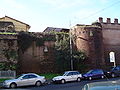


Photo: The British Library, CC0 · Wikimedia Commons
Fortress / Tower, 6th century BC
Porta Collina
Landmark in ancient Rome
- Within the UNESCO World Heritage Site “Historic Centre of Rome, the Properties of the Holy See in that City Enjoying Extraterritorial Rights and San Paolo Fuori le Mura”
At a glance
- Type
- Fortress / Tower
- Period
- Antiquity, 6th century BC
- Commissioned by
- Servius Tullius
- Coordinates
- 41°54′26″ N, 12°29′56″ E
About
The Colline Gate (Latin Porta Collina) was a landmark in ancient Rome, supposed to have been built by Servius Tullius, semi-legendary king of Rome 578–535 BC. The gate stood at the north end of the Servian Wall, and past it were two important streets, the Via Salaria and Via Nomentana. Within this area the Alta Semita linked the Quirinal with the Porta Carmentalis. Several temples were located near the gate, including temples of Venus Erycina and Fortuna. To a person facing the gate in the 4th century AD, the Gardens of Sallust would have been on the left, with the Baths of Diocletian on the right.
Plutarch says that, when a Vestal was punished for violating her vow of chastity, the subterranean chamber for her live burial was near the Colline Gate. The gate was the site of a decisive battle during the Roman civil wars of the 80s BC between the forces of Cinna and Sulla.
Text from Wikipedia, the free encyclopedia, under CC BY-SA 4.0. Full article: «Porta Collina».
Timeline
- 6th century BCBuilt
Events and people from Wikidata (CC0).
Photos
Getting there
Roma TerminiTrain, nearest
800 m as the crow flies
Porta Collina
Aeroporto di Roma-Ciampino14.3 km
Distances are as the crow flies, not walking or driving.
Loading map…
Nearby
See on the mapMore fortresses and towers in Lazio


- UNESCO


Frequently asked questions
Where is Porta Collina?
Porta Collina is in Rome, in the province of Roma (Lazio), Italy. GPS coordinates: 41.90722, 12.49889.
How old is Porta Collina?
Wikidata dates it to the 6th century BC.
What else is there to see near Porta Collina?
Nearby you’ll find: Palazzo delle Finanze (200 m away), Gardens of Sallust (200 m away), Villa Paolina (200 m away).
Sources and licences
Text. Wikipedia, the free encyclopedia (CC BY-SA 4.0).
Data. Wikidata (CC0); opening hours and contacts OpenStreetMap (ODbL).
Photos. Wikimedia Commons, author and licence on every image.
Credits for the 2 photos
- The British Library - Rome - Porta Collina — The British Library, CC0
- Planrome2b — Cassius Ahenobarbus, CC BY-SA 3.0
Updated 28 October 2026. All sources and licences