




- Free 1st Sunday
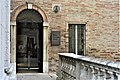
Photo: Stefano Sansavini, CC BY-SA 4.0 · Wikimedia Commons
Historic villa / palace, 1472
Building in Urbino, Italy
The Ducal Palace (Italian: Palazzo Ducale) is a Renaissance building in the Italian city of Urbino in the Marche. One of the most important monuments in Italy, it's been listed as a UNESCO World Heritage Site since 1998.
The construction of the Ducal Palace was begun for Duke Federico III da Montefeltro around the mid-fifteenth century by the Florentine Maso di Bartolomeo. The new construction included the pre-existing Palace of the Jole. The solid rock hillside salient was impregnable to siege but was problematic for carving out the foundation of a palace. Thus, a prominent fortress-builder, Luciano Laurana, from Dalmatia, was hired to build the substructure; but Laurana departed Urbino before the living quarters of the palace were begun. After Laurana, the designer or designers of the Ducal Palace are not known with certainty. Leading High Renaissance architect Donato Bramante was a native of Urbino and may have worked on the completion of the palace.
The Ducal Palace is famous as the setting of the conversations which Baldassare Castiglione represents as having taken place in the Hall of Vigils in 1507 in his Book of the Courtier.
The palace continued in use as a government building into the 20th century, housing municipal archives and offices, and public collections of antique inscriptions and sculpture (the Galleria Nazionale delle Marche, see below). Restorations completed in 1985 have reopened the extensive subterranean network to visitors.
The Ducal Palace featured several rooms that reflect Federico's devotion to Classical and humanistic studies and served his daily routine, which included visiting the palace's lararium and reading Greek literature. These learned and explicitly pagan touches were atypical of a medieval palazzo.
A central element in this plan is the studiolo (a small study or cabinet for contemplation), a room measuring 3.60 x 3.35m and facing away from the city of Urbino and towards the Duke's rural lands. Its intarsia wood inlaying, surrounding the room's occupant with illusionary trompe-l'œil shelves, benches, and half-open latticework doors displaying symbolic objects representing the Liberal Arts, is a famous example of this Italian craft of inlay. The benches hold replica musical instruments, the shelves contain reproductions of books and musical scores, simulated scientific instruments (including an astrolabe and an armillary sphere), study furnishings (including a two-dimensional writing desk and an hourglass), weapons and armor, and various other objects (e.g. parrots in cages and a mazzocchio).
The studiolo also features iconic representations of several persons, both contemporary and historical. On the intarsia panels are depicted statues of Federico in scholarly attire and of Faith, Hope, and Charity. Above the intarsia panels are portraits of great authors by Joos van Wassenhove (with reworking by Pedro Berruguete):
The upper register (shown in the diagram's outside rows and columns) presents Classical and humanistic writers, as opposed to the religious figures (broadly speaking) of the lower register (inside).
Downstairs from the studiolo are a twinned pair of chapels, one Christian and one pagan. The vestibule leading to them emphasizes their complementarity with this inscribed elegiac couplet:
The Temple of the Muses, which may have been used as the personal studiolo of Federico's son Guidobaldo, originally featured paintings of the Muses as "sober musicians" that are perhaps the work of Giovanni Santi.
Text from Wikipedia, the free encyclopedia, under CC BY-SA 4.0. Full article: «Palazzo Ducale».
Events and people from Wikidata (CC0).
Address
Piazza Duca Federico, Urbino
Distances are as the crow flies, not walking or driving.


Palazzo Ducale is in Urbino, in the province of Pesaro e Urbino (Marche), Italy. Address: Piazza Duca Federico, Urbino. GPS coordinates: 43.72424, 12.63599.
According to OpenStreetMap data, the site is partly wheelchair accessible.
Wikidata dates it to 1472.
Nearby you’ll find: Galleria nazionale delle Marche (0 m away), Raffaello Sanzio Theatre (0 m away), Palazzetto della Jole (100 m away).
Text. Wikipedia, the free encyclopedia (CC BY-SA 4.0).
Data. Wikidata (CC0); opening hours and contacts OpenStreetMap (ODbL).
Photos. Wikimedia Commons, author and licence on every image.
Updated 28 October 2026. All sources and licences