
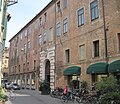


Photo: Rapallo80, CC BY-SA 4.0 · Wikimedia Commons
Historic villa / palace, 19th century
Palazzo San Crispino
Palace in Ferrara, Italy
Ferrara (FE), Emilia-Romagna
- Within the UNESCO World Heritage Site “Ferrara, City of the Renaissance, and its Po Delta”
At a glance
- Period
- Modern era, 19th century
- Style
- Neoclassical architecture
- Protection
- Italian national heritage
- Coordinates
- 44°50′06″ N, 11°37′16″ E
- Address
- Piazza Trento Trieste
History and description
The palazzo di San Crispino, also known as the oratorio dei calzolai o di San Crispino, is located in Piazza Trento e Trieste, on the corner of via Mazzini and via Contrari in Ferrara.
History
Popular tradition would have it that Charlemagne on his passage through Ferrara dedicated it to the art of shoemaking in 808 as a reward to a shoemaker for the services he had offered him. Historically speaking, it is certain that until 1561 it was the seat of public schools of fine arts, linked to the Studium of Ferrara, later partially destroyed by fire. Later, by decision of the shoemakers' guild, it was reduced to an oratory, while the public school from 1567 was moved to the new location of the Palazzo Paradiso.
The oratory was dedicated to the saints Crispinus and Crispinianus and this name has remained, even being used for a time to indicate the square on which it stands. According to tradition, Crispinus and Crispinianus were two young Christians sent from Rome as missionaries who were shoemakers by trade. During the period of the persecution of Christians in the Roman Empire they were urged to deny their faith but, not accepting it, the emperor Maximian condemned them to death. Their bodies were then hidden and preserved by some believers until the end of the persecutions. Deposited in two neighbouring sepulchres, the two saints would later be buried and the basilica dedicated to them in Soissons was built on their tomb. They are credited with the name that was chosen for the building, thus dedicated to the protectors of shoemakers.
When the ghetto was established in Ferrara, starting in 1627, in its premises the Jews were required to take part in predica obbligatorie.
Restoration
During the 19th century, the palace underwent major renovation by architect Giovanni Tosi, who transformed the previous historical loggia, giving it a neoclassical appearance that it still retains, and arranged some shops inside.
In the middle of the 1970s, work began to restore the ancient portico, but the operation was suspended after a short time due to various difficulties related to the property, although in the meantime the 18th-century pictorial and decorative elements were recovered, by Giuseppe Facchinetti and Francesco Pellegrini. Both painters around 1750 depicted the Glory of Saints Crispinus and Crispinianus in the vault of the hall. Despite various changes of ownership a 16th-century wooden ceiling in the loggia and the remains of medieval workshops on the back wall were preserved.
Work resumed at a later date after interruptions due to legal issues. The Regional Administrative Court in 1985 decided to award the building to the public authority, but the ruling was annulled shortly afterwards as illegitimate. The private property sent a plan for the allocation of the space and at ministerial level the response only arrived in 1988.
In 1675 the façade was frescoed (but such work was lost in the 19th century), above the loggia, by Francesco Ferrari, who depicted Charlemagne on a throne flanked by paladins on horseback.
Architect Tosi wanted to embellish the façade with large medallions representing civic virtues, in line with other decorations in the city. Together with Gaetano Davia, he therefore chose a number of illustrious men from Ferrara to be celebrated: Ludovico Ariosto was placed in the centre and Brizio Petrucci, Alfonso Lombardi, Benvenuto Tisi da Garofalo, Antonio Foschini, Teodoro Bonati and Leopoldo Cicognara were placed on the sides.
A partire dalla fine del XX secolo, il palazzo ospita una libreria.
Text from Wikipedia, the free encyclopedia, under CC BY-SA 4.0. Full article: «Palazzo San Crispino».
Timeline
- 19th centuryBuilt
Events and people from Wikidata (CC0).
Photos
Getting there
FerraraTrain, nearest
1.6 km as the crow flies
Palazzo San CrispinoPiazza Trento Trieste
Distances are as the crow flies, not walking or driving.
Loading map…
Nearby
See on the mapMore historic villas and palaces in Emilia-Romagna


- Free 1st Sunday
Frequently asked questions
Where is Palazzo San Crispino?
Palazzo San Crispino is in Ferrara, in the province of Ferrara (Emilia-Romagna), Italy. Address: Piazza Trento Trieste. GPS coordinates: 44.83488, 11.62123.
How old is Palazzo San Crispino?
Wikidata dates it to the 19th century.
What else is there to see near Palazzo San Crispino?
Nearby you’ll find: Palazzo Contrari (0 m away), Ferrara Cathedral Museum (100 m away), San Romano (100 m away).
Sources and licences
Text. Wikipedia, the free encyclopedia (CC BY-SA 4.0).
Data. Wikidata (CC0); opening hours and contacts OpenStreetMap (ODbL).
Photos. Wikimedia Commons, author and licence on every image.
Credits for the 5 photos
- Ferrara Oratorio San Crispino — Rapallo80, CC BY-SA 4.0
- Ferrara - Palazzo San Crispino — photo uploaded by RicciSpeziari Photographer: Riccardo Speziari, CC BY-SA 3.0
- Ferrara, palazzo San Crispino (01) — Gianni Careddu, CC BY-SA 4.0
- St. Crispino Palace — Sien, Public domain
- Ferrare 2010 49 (8195077139) — Alain Rouiller, CC BY-SA 2.0
Updated 28 October 2026. All sources and licences