


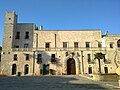


Photo: Fabrizio Garrisi, CC BY-SA 4.0 · Wikimedia Commons
At a glance
- Type
- Museum
- Area
- 2,640 m²
- Protection
- Italian national heritage
- Coordinates
- 39°55′44″ N, 18°09′40″ E
- Address
- Via della Zecca, 1 - Ugento
History and description
The New Archaeological Museum is an Italian civic museum set up in the former convent of Santa Maria della Pietà of the Observant Friars Minor, in Ugento in the province of Lecce.
History
The convent was built in the 15th century probably by the architect Francesco Colaci da Surbo. The structure remained a place of prayer and worship until 1866 when, following the unification of Italy and by virtue of the law on the suppression of religious congregations (royal decree 3036), the monastery was devolved to the State property and used as a barracks for real Carabinieri. Later, the premises of the former monastery were transformed into classrooms and municipal offices. The intended use of the convent changed again when, in 1961, the bronze statue of Zeus was found, completely by chance. Thus, in 1968, the Civic Museum of Archeology and Paleontology was founded, which, following the long restoration work, completed in 2009, took on the name of "New Archaeological Museum".
Architectural Description
The architectural structure is austere, in accordance with the model of Franciscan life. An essential convent, with the central cloister surrounded by the refectory and service rooms, small cells and a library on the first floor, which was decorated in the eighteenth century and called the Sala del Priore. Attached to the convent is the church of Santa Maria della Pietà, which once donated to the Congregation of Our Lady of Sorrows was dedicated to Saint Anthony of Padua. In the first half of the 17th century, this one underwent some alterations. To resize the cult building a side wall was built which created a cavity between the cloister and the church itself. This remodeling completely erased the pictorial cycle of the side chapels of the church, which came to light following the latest restoration work. The walled chapels open today to the right of the old main entrance, near the church, and can be visited.
The first chapel depicts the Madonna of Constantinople seated on the throne between San Bonaventura and San Francesco da Paola, dated 1598. In the lower part there is a fake balustrade with small columns from which a spiral design runs along the entire arch. In the centre, the medical saints Cosma and Damiano are depicted, separated by a quadrangular niche in which two sacred ampoules are depicted. In the second Chapel stands the Madonna del Latte: below the same Marian iconography there is a part of the fresco that bears a fleet of galleys, a clear reference to the Naval Battle of Lepanto in 1571. Under the tondo depicting the Coronation of the Virgin is there is an inscription bearing the name of the client Donna Aurelia Perreca. The fresco cycle is completed by a sixteenth-century iconography of the Virgin of the Rosary and by a part of the fresco depicting the Medici Saints Cosma and Damiano. The third is dedicated to the Annunciation, with frescoes depicting the Virgin Mary, St. Nicholas and St. Anthony of Padua. The fourth chapel is dedicated to the Crucifixion, with frescoes depicting the Desolate Virgin, St. John the Evangelist, the Cyrenean who takes the Cross of Christ on his shoulders and other representations relating to the passion and death of Jesus Christ. …
Current exhibition criterion
Currently the New Archaeological Museum is spread over two floors and houses finds ranging from Prehistory to the Middle Ages flanked by educational panels. The ground floor houses two of the most exceptional discoveries that have occurred since the sixties: the Tomb of the Athlete, discovered in 1970 in via Salentina and the reproduction of Zeus, a masterpiece of Magna Graecia bronzes, found in Ugento, in via Fabio Pittore in 1961 and kept in the National Archaeological Museum of Taranto. The first floor, in addition to the Antiquarium where all the finds from the old exhibition are kept, houses rooms dedicated to the necropolis of Ugento and the walls of the ancient city; other rooms are instead dedicated to the indigenous cults of Messapia. In fact, votive objects and terracotta statuettes dated to the Hellenistic Age from the ancient Ugentine port of Torre S. Giovanni, artifacts found in the archaic sanctuary of Monte Papalucio in Oria, casts of terracotta statuettes depicting archaic divinities are on display. Finally, on the upper floor, medieval ceramic objects of Ugento production, and coins are displayed, with particular attention to those belonging to the Ugento mint, and to the local prehistory and protohistory.
Text from Wikipedia, the free encyclopedia, under CC BY-SA 4.0. Full article: «New Archaeological Museum of Ugento».
Photos
Getting there
Ugento-TaurisanoTrain, nearest
3.1 km as the crow flies
New Archaeological Museum of UgentoVia della Zecca, 1 - Ugento
Aeroporto "Fortunato Cesari"34.7 km
Distances are as the crow flies, not walking or driving.
Loading map…
Nearby
See on the mapMore museums in Puglia (Apulia)


- Free 1st Sunday

- Free 1st Sunday

- UNESCO

Frequently asked questions
Where is New Archaeological Museum of Ugento?
New Archaeological Museum of Ugento is in Ugento, in the province of Lecce (Puglia (Apulia)), Italy. Address: Via della Zecca, 1 - Ugento. GPS coordinates: 39.92892, 18.16108.
What else is there to see near New Archaeological Museum of Ugento?
Nearby you’ll find: Ugento Castle (100 m away), Palazzo Rovito (200 m away), Castello baronale di Felline (3.9 km away).
Sources and licences
Text. Wikipedia, the free encyclopedia (CC BY-SA 4.0).
Data. Wikidata (CC0); opening hours and contacts OpenStreetMap (ODbL).
Photos. Wikimedia Commons, author and licence on every image.
Credits for the 7 photos
- 470.02 - Tomba dell'atleta, V sec. aC — Fabrizio Garrisi, CC BY-SA 4.0
- Ugento - Nuovo museo archeologico di Ugento - 2023-09-14 05-34-42 001 — Tommasopaiano, CC BY-SA 4.0
- Ugento - Nuovo museo archeologico di Ugento - 2023-09-15 16-52-32 001 — Tommasopaiano, CC BY-SA 4.0
- Ugento - Nuovo museo archeologico di Ugento - 2023-09-29 12-46-55 001 — Tommasopaiano, CC BY-SA 4.0
- Ugento - Nuovo museo archeologico di Ugento - 2023-09-29 18-58-10 001 — Tommasopaiano, CC BY-SA 4.0
- Ugento - Nuovo museo archeologico di Ugento - 2023-09-29 19-08-47 001 — Tommasopaiano, CC BY-SA 4.0
- Ugento - Nuovo museo archeologico di Ugento - 2023-09-29 20-31-16 001 — Tommasopaiano, CC BY-SA 4.0
Updated 28 October 2026. All sources and licences