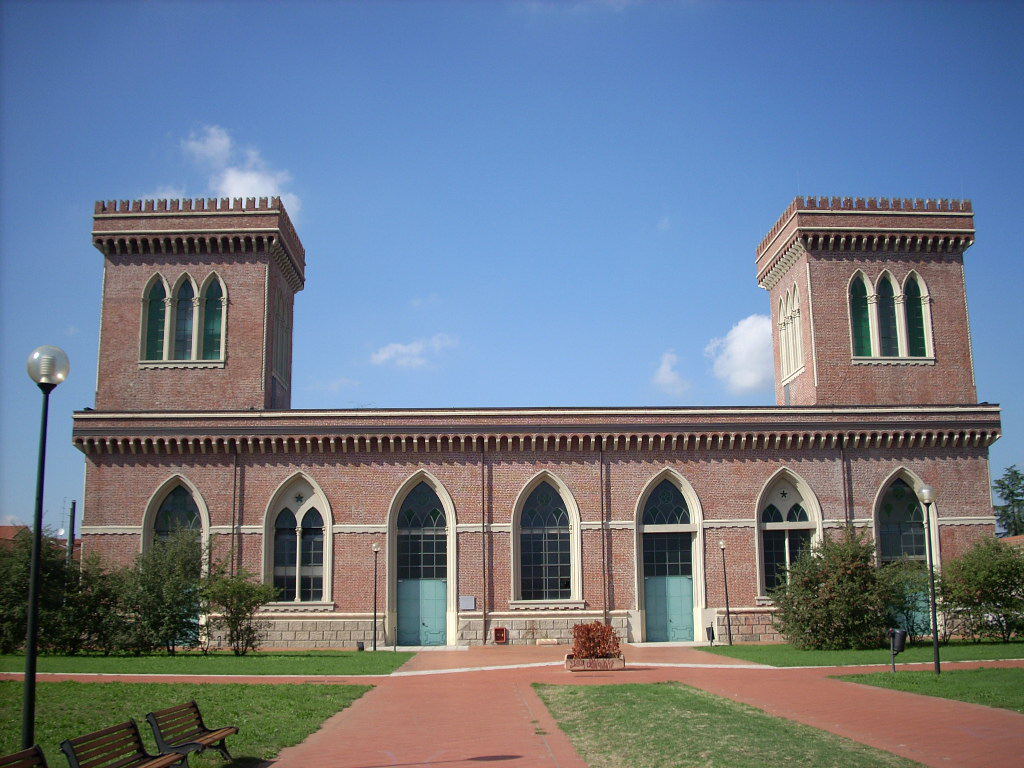


Photo: Trixt, CC BY 2.5 · Wikimedia Commons
Museum, 1896
Museum of Textiles and Industry of Busto Arsizio
Building in Busto Arsizio, Italy
Busto Arsizio (VA), Lombardy
- Free entry
At a glance
- Type
- Museum
- Period
- Modern era, 1896
- Style
- Gothic Revival
- Architect
- Camillo Crespi Balbi
- Protection
- Italian national heritage
- Coordinates
- 45°36′53″ N, 8°50′49″ E
- Address
- Via Alessandro Volta, 6, 21052 Busto Arsizio
History and description
The Museum of Textiles and Industry is one of the two museums in Busto Arsizio, Italy, that specialises in spinning and weaving. It was opened in 1997 to house objects, pictures and archive material representing Busto Arsizio's industrial history.
Purpose
The museum aims to:
Provide for the collection, preservation and promotion of objects coming from the local textile industry
Promote cultural activities and information to help scientific research, historical and artistic information available in the different areas of expertise around the Museum.
Ottolini’s Cotton Mill
The museum is located in one of the town's oldest industrial districts; Ottolini's Cotton Mill is, in fact, one of the first industrial settlements that was built outside the ancient centre of the former village of Busto Arsizio, in the immediate vicinity of St. Michael's.
The first project can be found in the National Archives of Varese in 1857. This building represents one of the best examples of the town's industrial archaeology, wisely maintaining its original features. In 1896, the building was designed with the characteristics of a brick-built medieval castle, with lancet windows, towers and battlements.
Recent history
On 19 January 1978, the Cotton Mill ceased production because of its outdated equipment. The town of Busto Arsizio acquired the entire area and started the creation of a public park. In 1994, reconstruction of the main building was started. These works led to the establishment of the museum as a reaction to the economic transformation in the area, to preserve objects and memories of everyday life and work as a cultural memory of the region.
On 30 January 1997, after some years of restoration, the museum was officially reopened. The museum has three floors as well as two towers and gives the opportunity to follow a wide itinerary, connected with the textile production that was for a long period of time the pride of the local economy. The ground floor and the first floor are equipped with an alternative route which has been specially designed for the visually challenged.
Exhibits
On the ground floor, in addition to a cafeteria and a conference room, there is also early spinning machinery, the large machines for weaving and finishing, and the first 19th-century systems for avoiding industrial accidents, such as fire extinguishers from the 19th century.
In this area, near the hall, there is an old carding system and machinery framing used within the domestic system. On the walls there are paintings illustrating the textile manufacturing process.
In the weaving department, there is the oldest and most important machine which deserves special attention as it originated from the old wood framing industry from 1813. This is a domestic hand loom used by peasant families.
Finally, there is a department dedicated to the life of the workers, plus the two towers one of which is devoted to photography whilst the other explores the myths of the industrial factory in Busto Arsizio.
The first floor is dedicated to the history of Jacquard manufacturing, from the original machinery to computers. This level is important for "the room of experiences", where you can touch the different stages of cotton preparation and you can also see the packaging and delivery of the products.
The Jacquard area showcases the different machines which were used for this specialist embroidery process.
In the display cabinets and depicted in the paintings are the old samples and original labels used by the leading local manufacturers from the mid-19th and early 20th century.
On the second floor, you can see the stages of dyeing and printing fabric and you can also find many finished products, from specialised outfits of this century to new synthetic fibres. This includes astronaut uniform, Formula 1 jumpsuits and fashion clothing such as a Valentino dress.
This section shows the original process of dyeing using vegetable colours, also showcased area ancient samples and original notes from chemists and dyers from the Busto area as well as Swiss and German workers form the Cantoni cotton mill.
In the printing area, there is a display of hand printing works and techniques. …
Text from Wikipedia, the free encyclopedia, under CC BY-SA 4.0. Full article: «Museum of Textiles and Industry of Busto Arsizio».
Timeline
- 1997Founded and opened
Events and people from Wikidata (CC0).
Photos
Getting there
Busto Arsizio NordTrain, nearest
1.0 km as the crow flies
Museum of Textiles and Industry of Busto ArsizioVia Alessandro Volta, 6, 21052 Busto Arsizio
Aeroporto internazionale Milano Malpensa "Silvio Berlusconi"9.6 km
Distances are as the crow flies, not walking or driving.
Loading map…
Nearby
See on the mapMore museums in Lombardy

- Free 1st Sunday


Frequently asked questions
Where is Museum of Textiles and Industry of Busto Arsizio?
Museum of Textiles and Industry of Busto Arsizio is in Busto Arsizio, in the province of Varese (Lombardy), Italy. Address: Via Alessandro Volta, 6, 21052 Busto Arsizio. GPS coordinates: 45.61483, 8.84683.
What are the opening hours of Museum of Textiles and Industry of Busto Arsizio?
According to OpenStreetMap the opening hours are: Tuesday to Thursday: 14:30–18:00; Friday: 9:30–13:00, 14:30–18:00; Saturday: 14:30–18:30; Sunday: 15:00–18:30. Always check the official website before your visit.
How much does it cost to visit Museum of Textiles and Industry of Busto Arsizio?
Entry is free.
Is Museum of Textiles and Industry of Busto Arsizio wheelchair accessible?
According to OpenStreetMap data, the site is wheelchair accessible.
How old is Museum of Textiles and Industry of Busto Arsizio?
Wikidata dates it to 1896.
What else is there to see near Museum of Textiles and Industry of Busto Arsizio?
Nearby you’ll find: Villa Ottolini-Tosi (100 m away), Agorà della Scherma (100 m away), Villa Ottolini-Tovaglieri (200 m away).
Sources and licences
Text. Wikipedia, the free encyclopedia (CC BY-SA 4.0).
Data. Wikidata (CC0); opening hours and contacts OpenStreetMap (ODbL).
Photos. Wikimedia Commons, author and licence on every image.
Credits for the 9 photos
- Busto Arsizio - Museo del tessile — Trixt, CC BY 2.5
- Busto Arsizio - Museo del tessile e della tradizione industriale di Busto Arsizio - 2026-09-27 21-47-34 001 — Ysogo, CC BY-SA 4.0
- Busto Arsizio - Parco Museo del Tessile — Yoda49, CC BY-SA 4.0
- La schirpa al museo del tessile di Busto Arsizio 01 — Sandra Grampa, CC BY-SA 4.0
- Macchinari al museo del tessile di Busto Arsizio — Sandra Grampa, CC BY-SA 4.0
- Modello di telaio al museo del tessile di Busto Arsizio — Sandra Grampa, CC BY-SA 4.0
- Museo del Tessile - Busto Arsizio 1 — Aldo Signorelli, CC BY-SA 4.0
- Museo del tessile -Busto Arsizio — Riccardo Rimoldi, CC BY-SA 4.0
- Museo del tessile (Busto Arsizio) - insieme1 — CristianNX, CC BY-SA 3.0
Updated 28 October 2026. All sources and licences