



Archaeological site, Gubbio (PG)
43°21′11″ N, 12°35′34″ E
No photo on Wikimedia Commons yet
Archaeological site
Monte Ansciano
Mountain and archaeological site in Italy
At a glance
- Type
- Archaeological site
- Coordinates
- 43°21′11″ N, 12°35′34″ E
History and description
Monte Ansciano is a mountain and archaeological site in Umbria, Italy. Alongside with Monte Ingino, the site at Ansciano overlooks the modern city of Gubbio.
History
The site belonged to the Proto-Villanovan Chiusi-Chetona archaeological complex, which encompassed parts of central and potentially northern Etruria. One type of artifact discovered at Ansciano, a class of winged axes with concave blade edges, is exclusive to this particular region. Excavations at Ansciano have also uncovered an oval hut and an ancient midden encircled by a wall, both dating back to the Final Bronze Age and Early Iron Age (1200-1000 BCE). Around 12,000 preserved remnants of animals such sheep, cows, and pigs dating to this same period were discovered at Ansciano, which perhaps reflects a type of ritual consumption practice. Moreover, archaeologists unearthed samples of ivory combs at Ansciano similar to others uncovered at Frattesina. There is little evidence for the usage of the site from the 10th-century to the 6th-century BCE, though there is one ritual deposit of a 9th-8th century BCE bronze and iron fibula. During the Late Bronze Age, there was a village situated on the slopes of Monte Ansciano.
Following the early Iron Age, Ansciano was later reused as a sanctuary space by the Umbrian people. Like other Umbrian sanctuaries, the site contained architectural remains—specifically, in the case of Ansciano, a dry-stone platform, which—in the 6th-century BCE—was placed atop the earlier Bronze Age wall. As is common for Umbrian ritual spaces, the Ansciano sanctuary is placed atop a mountain, though it exists upon a smaller peak than the Umbrian sanctuaries at areas such as Monte Pennino and Monte Maggiore, all of which are generally the tallest location in the nearby area. Numerous Umbrian artifacts were uncovered at Ansciano, including votive bronzes and pottery, perhaps with accompanying depictions of human faces, and an aes rude dated to the 3rd-century BCE. It is possible that religious activity at the site persisted following the Roman conquest, as indicated by the remains of Republican-era coins and lamps and drinking cups dating to the period of the Roman Empire. However, according to the archaeologist Guy Bradley, it is probable that any persistent usage of the site was infrequent. …
Text from Wikipedia, the free encyclopedia, under CC BY-SA 4.0. Full article: «Monte Ansciano».
Getting there
Ex Stazione FAC di PaduleTrain, nearest
4.5 km as the crow flies
Monte Ansciano
Aeroporto Internazionale dell'Umbria - Perugia "San Francesco d'Assisi"29.1 km
Distances are as the crow flies, not walking or driving.
Loading map…
The town
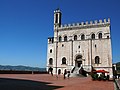
 Things to see in Gubbio30,479 inhabitants, 522 m above sea level. 40 historic places in the town.PhotoLabicanense, CC BY 4.040 places
Nearby
See on the mapDo you know this place?
We are missing the opening hours and photos. The data comes from open projects: if you add it there, it appears here at the next update.
More archaeological sites in Umbria


Frequently asked questions
Where is Monte Ansciano?
Monte Ansciano is in Gubbio, in the province of Perugia (Umbria), Italy. GPS coordinates: 43.35310, 12.59290.
What else is there to see near Monte Ansciano?
Nearby you’ll find: Palazzo dei Consoli (1.1 km away), Palazzo Ducale (1.1 km away), Palazzo del Bargello (1.3 km away).
Sources and licences
Text. Wikipedia, the free encyclopedia (CC BY-SA 4.0).
Data. Wikidata (CC0); opening hours and contacts OpenStreetMap (ODbL).
Updated 28 October 2026. All sources and licences