




- Most beautiful villages
Photo: Parma1983, CC BY-SA 4.0 · Wikimedia Commons
Gualtieri (Mantovano: Gualtēr) is a comune (municipality) in the province of Reggio Emilia, in the Italian region of Emilia-Romagna, located about 70 kilometres (43 mi) northwest of Bologna and about 25 kilometres (16 mi) north of Reggio Emilia on the right bank of the Po river. Historically, it suffered numerous floods, the last occurring in 1951. It is one of I Borghi più belli d'Italia ("The most beautiful villages of Italy").
In the 2nd century BC, with Roman colonisation, the territory was split up. The signs of centuriation still are evident not far from Brescello (Brixellum), a village around which the settlement of Gualtieri revolved until the Lombard Age.
885, date of the first certain document relating to Castrum Valterii (Castel Gualtieri).
1435, Gualtieri becomes a part of the Parmesan domains owned by the Sforza, the dukes of Milan. They then cede it to the dukedom of Ferrara in 1479.
1567, Cornelio Bentivoglio, the heir of one of the most important patrician families of Bologna, receives the territory of Gualtieri in fief from the duke Alfonso II d’Este as a reward for his commitment to the decontamination of the lowlands of Reggio.
1575, the fief of Gualtieri becomes a marquisate. In the renovation of the territories, Cornelio Bentoviglio was helped by the collaboration of Giovan Battista Aleotti, an architect expert in military constructions and the hydraulic sciences. The renovation was completed by his son Ippolito in 1604. The Bentivoglio Reclamation(1566-1618) is considered the most important hydraulic reclamation of the lower Po Plain until the 19th century.
1634, Enzo Bentivoglio, heir to the marquisate, returns the fief of Gualtieri to the Ducal Chamber of Modena.
1769, the entrepreneur Antonio Greppi from Milan starts a flourishing agricultural company in Santa Vittoria di Gualtieri based on the physiocratic principles of the Enlightenment, i.e. with the introduction of new methods in the cultivation of rice and tobacco occupying hundreds of day labourers.
1872, the most powerful flood of the 19th century was preceded by that of 1765 and then followed by the last disastrous flood of the Po in 1951.
1965, Antonio Ligabue dies near Gualtieri. He is considered the most important naïve painter in Italy.
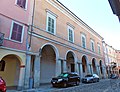
Gualtieri is surrounded by water and earth landscapes. One of the minor Po Valley capitals, it boasted a small court yet well equipped by the Bentivoglio marquises, masters of water and reclamation techniques. The palace stands in a square, beyond which the Po lies, giving rise to a sophisticated play of perspective and theatrical ambition. The designers, experts of theatrical arts in Ferrara, wanted to involve the audience in a symbolic and extraordinarily powerful production. Today we may still appreciate the De Chirico-esque atmospheres, found in the long shadow of the arcades, under whose arches we may hide from the summer heat. From the winter fog in the woods right behind the floodplains of the Po the ghost of Ligabue emerges, where he lived wildly with the leopards of his imagination.
Starting from Piazza Cavallotti and along Via Vittorio Emanuele II, we are inserted in a long perspective channel, closed at the bottom of the civic tower. As you approach the main square, the arch of the entrance of the tower lets you glimpse the façade of Gualtieri's main attraction: its Renaissance square Piazza Bentivoglio, designed by Giovan Battista Aleotti (also responsible of the Palazzo Bentivoglio, which was the residence of the Marquisses of Gualtieri). The latter has 17th-century decorations and houses a museum dedicated to the painter Antonio Ligabue. Also facing the square is the Collegiata di S. Maria della Neve, again designed by Aleotti but remade after its destruction from a flood, which houses a Crucifixion by Camillo Ricci.
Other sights include the 13th-century church of Sant'Andrea and the 16th-century church Chiesa della Concezione. About 6 kilometres (4 mi) outside Gualtieri, on the road to Reggio Emilia, is the 18th-century Palazzo Greppi.
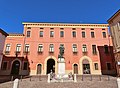
Moving forward, after crossing the threshold of the civic tower, the magnificent and bright square space of Piazza Bentivoglio (1594–1600) opens up in all its symbolic power before visitors. According to the art historian Cesare Brandi, this is one of the most beautiful squares in Italy. And as such it already appeared in its day when its function was simultaneously that of public square and courtyard of honour for the palace (today occupied by a large garden). The protagonist of this spectacular urban management was Prince Cornelio – then Ippolito – with the help of the engineer, architect and set designer Giovanni Battista Aleotti, known as "L'Argenta", active in Ferrara and Parma, where ten years later he would produce the Teatro Farnese (a Renaissance theatre in Palazzo della Pilotta). The urban landscape of Gualtieri, like other new cities of the Renaissance, was designed to include the old village within the new layout. In the square, three streets merge, opening up the perspective on the three main sites of interest: the palace, the church and the tower. …
Palazzo Bentivoglio offers guided tours of its rooms and painting cycles. Inside Palazzo Bentivoglio we can find the Antonio Ligabue Museum Foundation, as wells as Umberto Tirelli Donations. In the former, the Naive painter's life is reconstructed with bibliographical and iconographic materials. His art, which lies between primitivism and expressionism, is not structured on a cultural basis, but on the farmer's genius and on a strong psychoanalytical element. Ligabue lived alone like a wild man in Gualtieri, in the woods and Po floodplains. On the other side, Umberto Tirelli (1928–90) was a great theatre costume designer, a reference point for major directors in cinema and theatre: he not only donated the collection of historical costumes to his small town, but also his small private picture gallery, made up of, of more or less fifty drawings and oil paintings, purchased by him or given by friends.
Text from Wikipedia, the free encyclopedia, under CC BY-SA 4.0. Full article: «Gualtieri».
Distances are as the crow flies, not walking or driving.


Gualtieri is in Gualtieri, in the province of Reggio Emilia (Emilia-Romagna), Italy. GPS coordinates: 44.90000, 10.63333.
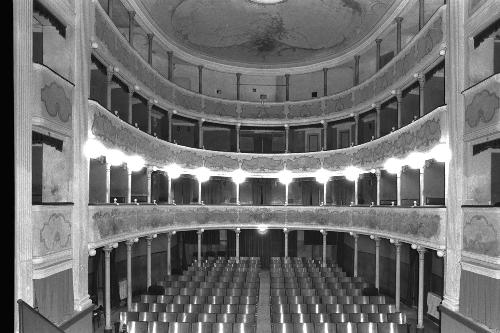
Nearby you’ll find: Palazzo Bentivoglio (600 m away), Teatro comunale di Gualtieri (600 m away), Teatro comunale Ruggero Ruggeri (2.8 km away).
Text. Wikipedia, the free encyclopedia (CC BY-SA 4.0).
Data. Wikidata (CC0); opening hours and contacts OpenStreetMap (ODbL).
Photos. Wikimedia Commons, author and licence on every image.
Updated 28 October 2026. All sources and licences