



- Most beautiful villages
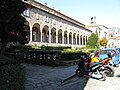
Photo: Trebbia, CC BY-SA 3.0 · Wikimedia Commons
Bobbio (Bobbiese: Bòbi; Ligurian: Bêubbi; Latin: Bobium) is a small town and comune in the province of Piacenza in Emilia-Romagna, northern Italy. It is located in the Trebbia River valley southwest of the town Piacenza. There is also an abbey and a diocese of the same name.
Bobbio is the administrative center of the Unione Montana Valli Trebbia e Luretta. It is one of I Borghi più belli d'Italia ("The most beautiful villages of Italy").
Bobbio is located in the heart of Val Trebbia, a valley described by Ernest Hemingway as "the most beautiful in the world". The town is nestled at the foot of Monte Penice, 1,460 metres (4,790 ft) above sea level, on the left bank of the river Trebbia.
Its history is identified with the Abbey founded in 614 by St. Columbanus an Irish missionary, and as a result, it became one of the principal centres of religious culture in medieval Italy, home to a library and basilica. The possessions of the abbey in the Lombard and Carolingian eras spanned the north of Italy.
Bobbio is a coveted tourist destination known for its history of art and culture, for nature lovers, and for its ancient monuments. It has from antiquity been a crossroads between different cultures such as the Piacentine, Ligurian, Piedmontese and Pavian.
The historical centre and heart of the city has maintained the characteristics of the medieval village. One town landmark, the Ponte Vecchio, called Ponte Gobbo (Hunchback Bridge), also known as the Devil's Bridge, is an ancient stone bridge of Roman origin, which crosses the river Trebbia in eleven irregular arches. The Shrine of Our Lady of Penice, located on top of Monte Penice, dominates the landscape, and is also visited in winter for its ski resorts.
Historians have speculated that Bobbio was the town in which Leonardo da Vinci completed the Mona Lisa.
Carla Glori in December 2011 has published her book Enigma Leonardo:decifrazioni e scoperte where the background of the portrait has been identified as the landscape of Bobbio.
Bobbio is 45 kilometres (28 mi) from Piacenza and from there it can be reached by the state road n. 45, which connects Piacenza to Genova. From Pavia, the route to Bobbio is via road n. 461 and Pass Penice.
From Bobbio, the road to Piacenza is only a few minutes from Barberino Orrido, an overlook of the river Trebbia. Continuing in the same direction you enter the village of Mezzano Scotti, and a few kilometres afterwards, the little village called Perino. It is an ideal starting point for visiting the Perino Valley or the ancient characteristic villages of Aglio and Pradovera.
On the same road but in the direction of Genova and 4 kilometres (2 mi) from Bobbio is San Salvatore, a little village with a wonderful view of the river's meanderings. A few kilometres upstream is Marsaglia and Brugnello, with the ancient Church of Brugnello overlooking the river Trebbia.
From Bobbio, taking the state road n. 461 for Pavia after 12 kilometres (7.5 mi) you reach Passo Penice (1145 m) where there is a ski resort on the top of the Monte Penice (1460 m). This is the location of the ancient Virgin Penice Sanctuary with a view of the region; a few kilometres downhill, near Ceci, is a cross country ski run.
On the other side of the river just 10 kilometres (6 mi) from Bobbio is the village of Coli, situated between pinewoods and pasture fields.
The river Trebbia is the backbone of Bobbio and its surrounding territory. It springs in Liguria on Mount Prelà and flows 120 kilometres (75 mi) to reach the river Po. Its waters are fresh, clean and run between stones and rocks outlining a twisting journey through overhangs and waterfalls.
The Trebbia valley is known among international scholars for its geology.
Common activities on the river include hiking, swimming, sunbathing, canoeing, canyoning and fishing. Trout, balbels and chubs can be found in the river.
The territory around Bobbio is characterized by the Apennines, which influence the climate, contributing cool air in summer and protecting the town from cold winds and fog in winter. On the surrounding mountains are find cultivated fields and pastures, and the woods are habitats for a number of critters (squirrel, dormouse, hedgehog, hare, badger, fox, wolf, wild boar, pheasant, partridge, and many birds) and where a great variety of trees and flowers grow (aromatic herbs, broom, beech, oak, pine, chestnut, spruce, larch).
Known to the ancients as Bobium or Ebovium, the town underwent many settlements from the Neolithic Age up to the contemporary one. Several archaeological finds testify to the presence of Liguri, Boii (Gauls of Celtic origin), and from the 4th century BC the Romans.
But the history of Bobbio is tied to the existence of the Abbey founded in 614 by the Irish monk Saint Columbanus (It. Colombano), who received the district from the Longobard King Agilulf.
Bobbio Abbey increased its possessions and became one of the principal seats of culture and religion of Northern Italy and a centre of learning during the Middle Ages, and was renowned for its Scriptorium and library. In the 10th century, there were 700 codices; but its decline in the 15th century led to the dispersal of the library. The monastery was officially suppressed by the French in 1803.
This monastery was in part the model for the great monastery in Umberto Eco's 1980 novel The Name of the Rose.
In 1014 Bobbio was erected a City and Episcopal See and surrounded by city walls that form the Contea of Bobbio.
The city lay in the region of Liguria but in 1230 Piacenza conquered Bobbio and its dominion lasted until the 14th century when the Contea of Bobbio passed, first, under the rule of the Malaspina, and then under the rule of the Visconti, the dukes of Milan.
In 1387 the city passed to the Dal Verme family and formed the Contea of Bobbio and Voghera; in 1516 the area formed the Marchesate of Bobbio.
The town became part of the domains of the House of Savoy in 1748 after the Wars of Succession and formed the Province of Bobbio.
In 1796 the French arrived in Italy and only four years later Napoleon suppressed the monastery and sold its treasures.
From 1815 to 1859 Bobbio and its province were included in the Department of Genoa, then passed to Pavia and finally in 1923 to Piacenza.
On 7 July 1944, the partisan resistance in Italy conquered the town, formed the Republic of Bobbio and governed it autonomously until it was crushed by the Germans on 27 August, the same year.
The bishopric dates from 1014. On 30 September 1986, the Diocese was suppressed and merged with Archdiocese of Genoa. Since 1989, Bobbio has been united with the Diocese of Piacenza to form the Diocese of Piacenza-Bobbio.
Text from Wikipedia, the free encyclopedia, under CC BY-SA 4.0. Full article: «Bobbio».
Our data shows no stations, stops or car parks nearby. Check how to get there before you set out.


Bobbio is in Bobbio, in the province of Piacenza (Emilia-Romagna), Italy. GPS coordinates: 44.77150, 9.38640.
Nearby you’ll find: Ex Chiesa e ex Convento di San Francesco (200 m away), Museum of the City of Bobbio (400 m away), Museo di San Colombano (400 m away).
Text. Wikipedia, the free encyclopedia (CC BY-SA 4.0).
Data. Wikidata (CC0); opening hours and contacts OpenStreetMap (ODbL).
Photos. Wikimedia Commons, author and licence on every image.
Updated 28 October 2026. All sources and licences