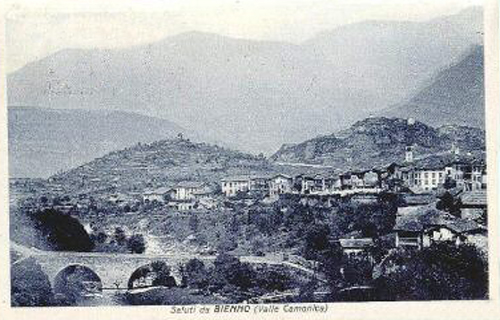




Photo: Sconosciuto - Unknown, Public domain · Wikimedia Commons
Historic village
Bienno
Italian comune
At a glance
- Type
- Historic village
- Elevation
- 445 m above sea level
- Area
- 30,540,000 m²
- Coordinates
- 45°56′12″ N, 10°17′39″ E
History and description
Bienno (Camunian: Bién) is an Italian comune in Val Camonica, province of Brescia, Lombardy. It is one of I Borghi più belli d'Italia ("The most beautiful villages of Italy").
History
In 1295 a dispute occurred with the neighbouring village Bovegno regarding some high pastures.
On 25 January 1350 the bishop of Brescia invested iure feuds for a tenth of the rights in the territories of the Municipality of Bienno (vicinia) and men of Bienno. This also happened back in 1295, 1336, and later in 1388, 1423 and 1486.
In 1391 the land of Bienno, which sided with the Ghibellines, was the site of extensive cattle raiding by the Guelph Camuni, led by Baroncino Nobili of Lozio.
The peace of Breno was signed on 31 December 1397 by the representative of the community of Bienno, Lanini Bertolino di Martino, who was a Ghibelline.
Between 1805 and 1815 the town of Bienno was united to Prestine and called "Bienno with Prestine."
Main sights
Bienno is part of the club of "The Most Beautiful Villages in Italy" creation of the Council of Tourism of the Association of Italian Municipalities (ANCI).
The parish church, dedicated to Saints Faustino and Giovita, was rebuilt in the early years of 17th Century strictly in accordance with Counter-Reformation rules; a single nave with six side altars; impressive painting cycle mostly made by Giovanni Mauro della Rovere (also known as Il Fiamminghino); a beautiful wrought iron gate dating back to 1647; a 17th-century organ made by members of the Antegnati family and remodeled by Serassi.
The smallest church in the lower part of the old town, the Chiesa di Santa Maria Annunziata (once called Santa Maria degli Orti). In its single nave, it contains frescoes of great value produced during the 16th century by various artists, including Giovanni Pietro da Cemmo and Romanino. The frescoes also include, among various subjects, a danse macabre to the right of the altar.
Hermitage of St. Peter and Paul, built in the second half of the 20th century, but originated in the 11th or 12th century, when Cluny monks came to Valcamonica.
Church of San Defendente on a hill at the north entrance of Bienno dating back to the 15th century.
Church of St Peter ad Vincula (or San Peder Suc) of 16th century. It is built onto a Roman altar of Bacchus (hence the name St. Peter Succo) of which you can see the remains in the back of the building.
Hill of Christ the King: there stands a monument to Christ the King, a golden statue erected in 1931.
Chapel of the pools (Cappella delle piscine), dating back to the 15th century and reworked in the 17th century.
The House of Panteghini, built in 1483.
The House of Bettoni dated of 1550.
The Simoni-Fè Palace, was given in 1932 to the municipality by the Countess Paolina Fè of Ostiani Montholon
when she left, after a fatal hunting accident caused by her husband, Count Jean Charles Tristan de Montholon, son of Charles Tristan, marquis de Montholon, suspected to have poisoned the Emperor Napoleon, in Saint Helena, and brother of Hélène Napoleone Bonaparte de Montholon, whose father could be Napoleon and who lived 90 years, …
Traditions and folklore
The scütüm are in camunian dialect nicknames, sometimes personal, elsewhere showing the characteristic features of a community. The one which characterize the people of Bienno is Padèle.
On 28 June, the eve of feast of Saints Peter and Paul, the villagers put an egg white in a bottle which they leave in the open air until the next morning; albumin coagulated in filaments then evokes the masts and sails of a boat, it is the boat of Saint Peter.
Text from Wikipedia, the free encyclopedia, under CC BY-SA 4.0. Full article: «Bienno».
Photos
Getting there
Cividate-MalegnoTrain, nearest
2.1 km as the crow flies
Bienno
Distances are as the crow flies, not walking or driving.
Loading map…
Nearby
See on the mapMore historic villages in Lombardy

- Most beautiful villages

- UNESCO
- Most beautiful villages

- Most beautiful villages

- Most beautiful villages

- Most beautiful villages
Frequently asked questions
Where is Bienno?
Bienno is in Bienno, in the province of Brescia (Lombardy), Italy. GPS coordinates: 45.93667, 10.29417.
What else is there to see near Bienno?
Nearby you’ll find: Etnographic museum of iron, arts and popular traditions (600 m away), Ancient Roman theatre (1.4 km away), Torre di Cividate Camuno (1.4 km away).
Sources and licences
Text. Wikipedia, the free encyclopedia (CC BY-SA 4.0).
Data. Wikidata (CC0); opening hours and contacts OpenStreetMap (ODbL).
Photos. Wikimedia Commons, author and licence on every image.
Credits for the 9 photos
- Bienno old 1928 — Sconosciuto - Unknown, Public domain
- Bienno (126317467) — Matteo Slanzi, CC BY 3.0
- Bienno (valle Camonica)interno di un cortile - panoramio — pacj, CC BY 3.0
- Bienno (valle Camonica)vecchi mestieri,la macina - panoramio — pacj, CC BY 3.0
- Bienno Borgo Antico — Laurom, Public domain
- Bienno Colle di Cristo Re — Dedi.otto, CC BY-SA 4.0
- Bienno-le-spongade — Albertomos, Public domain
- Bienno,(valle Camonica) tapezzeria esterna - panoramio — pacj, CC BY 3.0
- Blue Hour In Bienno (152561245) — Matteo Slanzi, CC BY 3.0
Updated 28 October 2026. All sources and licences