


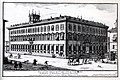

Photo: Unknown author Unknown author, Public domain · Wikimedia Commons
Historic theatre
Anfiteatro Correa
Former theatre in Rome (1780-1936)
- Within the UNESCO World Heritage Site “Historic Centre of Rome, the Properties of the Holy See in that City Enjoying Extraterritorial Rights and San Paolo Fuori le Mura”
At a glance
- Type
- Historic theatre
- Coordinates
- 41°54′22″ N, 12°28′35″ E
History and description
The Anfiteatro Correa was an amphitheatre in 1870 in Rome, Italy and was later known as the Anfiteatro Umberto I. In 1908, the theatre was transformed into a concert hall known as the Teatro Augusteo.
History
The amphitheatre was built on the remains of the Mausoleum of Augustus in Campo Marzio at the behest of the Portuguese Marquis Vincenzo Mani Correa, who resided at Piazza San Lorenzo in Lucina and was the owner of a palace built against the Mausoleum as well as of the imperial ruin itself.
The name Corea came from Romanesco, which tends to elide the doubling of the consonant "r", reducing it to a single consonant. The habit ended up changing the surname of the Marquis as well, who was later called Corea: Via del Corea, located in the vicinity of the former amphitheatre, was named after him.
A garden had been created in the interior of the mausoleum a long time before. A tenant of Spanish origins named Matas equipped it with wooden scaffolding, thus creating a circular arena with bleachers intended for horse shows, tournaments with animals, hunts and fireworks (at the time called fochetti, Romanesco for "little fires"): it had a total capacity between one thousand and three thousand spectators. The inauguration took place on 3 July 1780.
In 1802 the amphitheatre was acquired by the Apostolic Camera: it allowed the performance of circus and animal shows, which have always been highly appreciated by the Roman people. …
The demolition and the reorganization of the space around the mausoleum
The life of the theatre ended under Fascism: in 1937 the whole area once called Schiavonia (due to the presence of the church of St. Jerome of the Slavs and of some houses belonging to their congregation) was razed, as part of Mussolini's campaign of demolishment of the Renaissance urban fabric of Rome intended to isolate the remains of the imperial monuments.
The area of the Mausoleum of Augustus was therefore completely rebuilt, and the monument was surrounded by the porticoed quadrilateral of Piazza Augusto Imperatore designed by the architect Vittorio Ballio Morpurgo. The clearly rationalist project provided for considerable cubages of new buildings covered in travertine, including the shrine of the Ara Pacis.
After the demolitions, the memory of the theatre remained in the toponymy of the town: the street between Via della Frezza and Piazza Augusto Imperatore still retains the name of "Via del Corea".
Text from Wikipedia, the free encyclopedia, under CC BY-SA 4.0. Full article: «Anfiteatro Correa».
Timeline
- 1780Opened
Events and people from Wikidata (CC0).
Photos
Getting there
FlaminioTrain, nearest
800 m as the crow flies
Anfiteatro Correa
Aeroporto di Roma-Ciampino15.3 km
Distances are as the crow flies, not walking or driving.
Loading map…
Nearby
See on the mapMore historic theatres in Lazio


Frequently asked questions
Where is Anfiteatro Correa?
Anfiteatro Correa is in Rome, in the province of Roma (Lazio), Italy. GPS coordinates: 41.90600, 12.47640.
What else is there to see near Anfiteatro Correa?
Nearby you’ll find: Mausoleum of Augustus (0 m away), Ara Pacis (100 m away), Studio Canova (200 m away).
Sources and licences
Text. Wikipedia, the free encyclopedia (CC BY-SA 4.0).
Data. Wikidata (CC0); opening hours and contacts OpenStreetMap (ODbL).
Photos. Wikimedia Commons, author and licence on every image.
Credits for the 4 photos
- Giostra dei tori al mausoleo d'Augusto (1780) — Unknown author Unknown author, Public domain
- Mausoleo di Augusto 17 — Hugo DK, CC BY-SA 4.0
- Nolli 02 - mausoleo di Augusto — Lalupa, CC BY-SA 3.0
- Peracvestigi157537 — Étienne Dupérac, Public domain
Updated 28 October 2026. All sources and licences